


The origins of Kasuga Entertainment Center
This page introduces the origins of KASUGA GORAKUJOU, interweaving the history of game centers and the changes in the streetscape of Shinsekai, Osaka. It is a memory of Kasuga Amusement arcade, which survived through the Showa and Heisei eras.

Postwar reconstruction: a town of workers
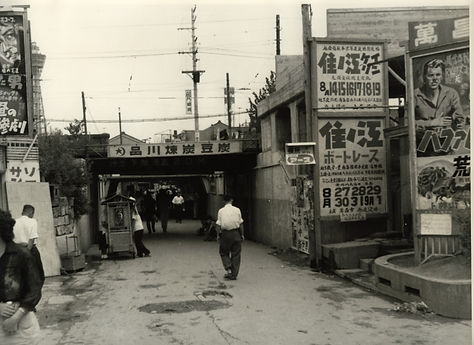
Shinsekai in Osaka is close to Kamagasaki (now Airin district), where workers gathered, and after the war it flourished as a place to provide food and entertainment for them. At that time, Kasuga Entertainment Center operated a Chinese restaurant and a diner.
02
From dining hall to entertainment venue
At the time, Shinsekai was home to many movie theaters, theatres, and shogi (Japanese chess) parlors . The founder, anticipating a future in which entertainment machines would evolve in line with the dramatic technological advances in home appliances and automobiles, decided to abandon his restaurant business and change his business to an entertainment venue around 1959. He opened the Kasuga Club, which offered mahjong parlors and arrange ball games.


03
Thinking of Niigata,
The founder was born as the fourth son of a rice farmer in Niigata, but because he was not the eldest son he was unable to take over the family business, so he decided to go into business to make a living and moved to Osaka. The "Kasuga" in Kasuga Entertainment Center is named after Kasugayama Castle, the residence of Uesugi Kenshin in Niigata. It is easy to imagine that he had a strong attachment to Niigata, where he was born and raised.
Photo courtesy of Joetsu Tourism Convention Association
04
A place offering a variety of game consoles
There were flippers, early crane games (which offered cigarettes as prizes), shooting games, early medal games such as "Sigma Big & Small" and "Burley Super Continental", etc. There were also many slot machines and poker games like those found in Las Vegas casinos.
Apparently there was also a table tennis court in the basement at the time.


04
Invader Boom
Kasuga Amusement Center has taken the plunge from flippers and crane games to become a fully-fledged arcade, riding the wave of the Invader craze. From now on, our store will move forward with two wheels: video game machines and medal game machines.
05
Game Centers in full swing
In the arcade game world, upright video games took over from tabletop games, and interactive games such as Sega's Hang-On became more common. In the 90s, the hit Street Fighter II ushered in a fighting game boom, and game centers continued to dominate entertainment. At its peak, Kasuga Entertainment Center expanded to four stores (each with a different name).


06
What the Decline of the New World Revealed
Meanwhile, after the collapse of the bubble economy, Shinsekai began to decline as a dirty, scary town due to the aging of the workforce. Festival Gate, which opened in 1997, closed within 10 years. However, Shinsekai gradually began to flourish as a tourist destination, offering kushikatsu and the traditional Osaka streetscape.
07
From arcades to amusement facilities
From the 2000s onwards, small game centers that primarily featured video games entered a dark age. The causes of this were the soaring cost of circuit boards, pay-per-use charges, and the increasing performance of home game consoles. Instead, there was an increase in game centers and amusement facilities that primarily featured photo booths and UFO catchers. There was apparently a time when KASUGA GORAKUJOU was unsure whether to close down.

08
Recovery from the fire
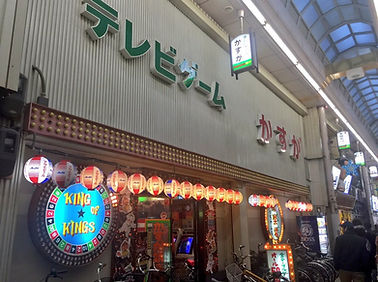
In 2017, our store caught fire due to arson by a thief. Many of the game machines were broken, but the staff at the time worked hard to repair them and the store is now almost back to normal. One of the illuminated signs was burned, but the entrance was also renovated and the current brown exterior wall was installed.
09
COVID-19
In 2019, while the scars of the fire had still not yet healed, the COVID-19 pandemic raged, and game centers were forced into a near-death situation, unable to receive the compensation provided to restaurants and other businesses for business closures. At the time, many customers were saved by charity keychains donated by small game centers.


10
Game Center: From Reiwa to Myth
In the Reiwa era, children who don't know what a "start button" is touch the CRT, and young men and women who don't understand the meaning of levers hold the 2P lever with their right hand and operate the 1P button with their left hand.
It looks like we are entering an era where people will say, "There used to be game machines like this in game centers."
No, no, there's still a long way to go!
(Created December 2025)